







Jump straight to:
- Address Validation vs. Address Verification
- Why Enterprises Require More Than Basic Validation
- The Essential Address Verification Solution
- Why Melissa?
- FAQ
Address Validation vs. Address Verification
What is address validation?
Address validation assesses whether an address is correctly structured, complete and formatted according to postal standards.
It helps answer:
“Does this address appear correct?”
Validation usually checks for:
- Structure of street, city, state and postal code
- Formatting and abbreviations
- Missing or misplaced elements
- Consistency in postal syntax
What is address verification?
Address verification takes it a step further. It confirms whether an address is legitimate, recognized by authoritative reference data and capable of receiving mail.
It helps answer:
“Can this address actually receive mail or shipments?”
Verification typically checks:
- Existence of the address
- Deliverability of the address
- Validity of suite or apartment details
- Possibility of correcting or appending missing data
The Key Distinction
An address validation tool may accept a record because it is complete and properly formatted.
An address verification tool goes further by confirming if the location is recognized by postal authorities and whether delivery is possible down to the unit level.
For businesses focused on shipping success, direct mail performance, customer experience, fraud prevention and CRM accuracy, the strongest approach is to use both validation and verification together as part of a complete address quality strategy. That extra layer is what makes verification essential for organizations.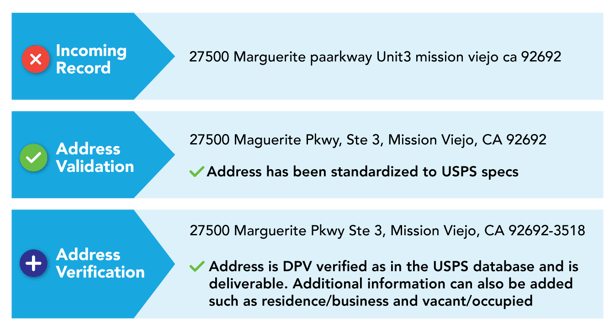
Why Enterprises Require More Than Basic Validation
Basic address validation is useful at the point of entry, but enterprise organizations typically need more than formatting rules alone. At scale, address verification supports measurable business outcomes, including:
- Enhanced data quality across systems
- Reduced shipping and mailing costs
- Improved customer experience
- More accurate CRM and analytics
- Stronger compliance and risk controls
- Cleaner onboarding and service workflows
For U.S. operations, businesses should look for solutions that use authoritative postal data and are backed by CASS and DPV capabilities. CASS (Coding Accuracy Support System) is a USPS program that evaluates the accuracy of address-matching software and its ability to standardize and code addresses correctly, including elements such as ZIP Code, ZIP+4 and carrier route data. DPV (Delivery Point Validation) adds another layer by confirming that an address is deliverable, including whether delivery can be made to the specific address and, when applicable, to the correct apartment or suite number.
Together, CASS and DPV play a vital role in differentiating between basic formatting and genuine deliverability-focused verification. A provider that is CASS/DPV certified goes beyond just checking if an address looks correct; it uses postal-aligned processes to ensure that the address is standardized, recognizable and has a greater likelihood of successfully reaching its intended destination.
This type of data can enhance fulfillment, communication, analytics and customer operations, allowing for increased confidence in these processes.
The Essential Address Verification Solution
As enterprises modernize their customer data strategies, maintaining address accuracy will continue to be essential for operational resilience, regulatory compliance and digital customer experience.
The most effective solutions will surpass simple address validation, incorporating address verification that enhances correction, enrichment and dependable delivery results on a large scale.
Why Melissa?
Melissa is an excellent choice for organizations that require address verification to enhance data quality and support scalable business operations. By integrating licensed postal data with a vast network of official postal and technology partners, along with extensive address expertise, Melissa empowers businesses to confidently verify, standardize, correct and enrich their address data.
Melissa has established official postal partnerships and licensed postal data agreements with notable organizations such as USPS, Canada Post, Royal Mail, Deutsche Post, La Poste, Australia Post and Correios. Additionally, Melissa offers seamless integrations with popular business platforms, including Salesforce, Microsoft Dynamics, Shopify, Stripe, Snowflake, Talend, Semarchy, Excel, Microsoft 365 and Google Sheets. This allows organizations to enhance address quality within their existing workflows rather than creating a separate data process.
For enterprises seeking long-term control over their customer data, Melissa emphasizes data ownership, allowing organizations to store and use validated address results in their own databases without ongoing reliance on external sources. Together, these attributes make Melissa particularly valuable for businesses that require reliable address verification to ensure deliverability and operational resilience. Read to try out Melissa's data verification solutions? Click here to request a demo.